
Can't Evacuate Before a Hurricane? Do This Right Now
6 min read
On this page
- When Evacuation Isn't Possible
- 1. Tell Someone Where You Are
- 2. Choose the Safest Room and Move Into It Early
- 3. Bring Your Supplies Into That Room
- 4. Store Water Before the Taps Stop Working
- 5. Charge Everything, Then Conserve Power
- 6. Handle Utilities and Outdoor Items
- 7. During the Storm: Rules That Save Lives
- 8. After the Storm: Wait, Then Check Carefully
- The Bottom Line
If you're staying put as a hurricane approaches, here's how to shelter safely at home — step by step, using official FEMA, NOAA, and Ready.gov guidance.
When Evacuation Isn't Possible
Hurricane evacuation orders are issued for a reason, and the safest choice is always to leave when officials tell you to. But sometimes leaving isn't an option: the order comes late, your vehicle won't start, a medical condition makes travel dangerous, or you simply have no way out. If that's your situation, you are not out of options.
According to the National Hurricane Center, water — not wind — is responsible for most hurricane-related deaths in the United States, and much of that danger comes from flooding that continues well after landfall. That tells you where to focus your effort: get to a safe interior space before the winds arrive, and stay away from rising water.
Here's what to do, in order, based on guidance from Ready.gov, FEMA, the National Weather Service, and the CDC.
1. Tell Someone Where You Are
Before the storm cuts power or phone service, let a friend or relative outside the area know your address, your phone number, and that you are sheltering in place. If you have a medical condition, mobility limitation, or no way to leave, contact your local emergency management office now — not during the storm — to let them know. Reserve 911 for a genuine, immediate emergency; call volumes spike and response may be suspended once winds reach dangerous levels.
2. Choose the Safest Room and Move Into It Early
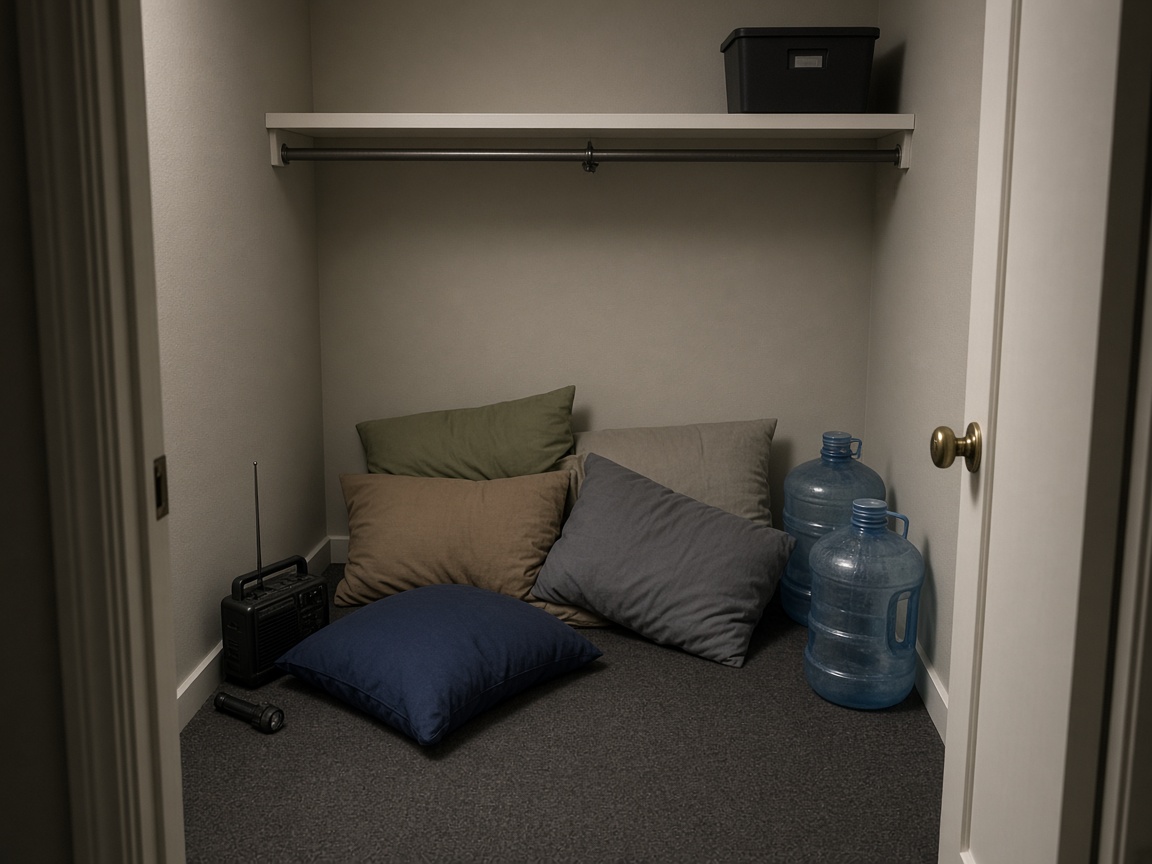
Do this while you still have time and light. The safest place in a home during a hurricane is a small interior room on the lowest level that is not at risk of flooding — a bathroom, closet, or hallway with no windows.
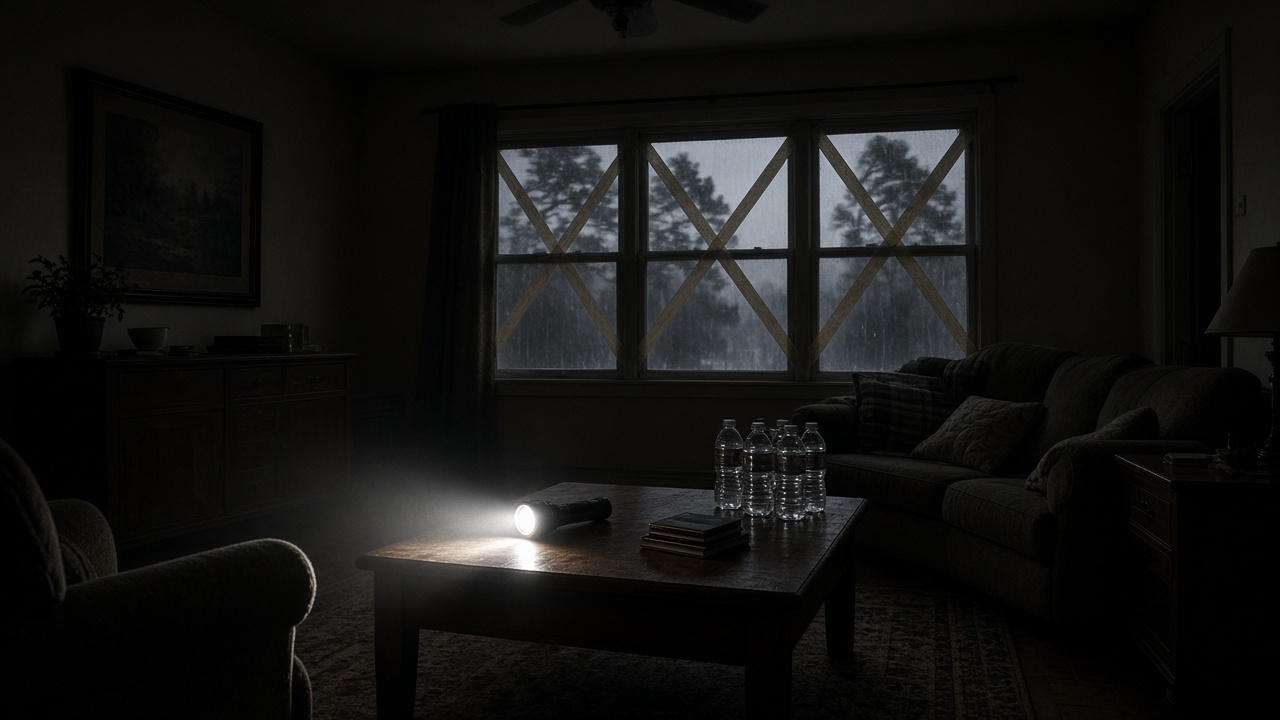
- Avoid all windows, glass doors, and skylights. Taping windows does not protect them and is not recommended by emergency officials.
- Stay off the top floor during high wind, unless flooding forces you upward.
- Do not shelter in a garage. Garage doors fail easily in high winds.
- Mobile and manufactured homes are not safe in a hurricane, even a weak one. If you can reach a designated public shelter or a sturdy nearby building, go now. If you truly cannot, the interior of a well-built structure is better than a mobile home — ask a neighbor or nearby business if you can ride out the storm with them.
3. Bring Your Supplies Into That Room
Gather everything before the storm arrives so you're not moving around the house in the dark or in high winds. Ready.gov recommends a basic kit with:
- At least one gallon of drinking water per person per day for several days, plus water for pets
- Non-perishable food and a manual can opener
- Prescription medications, a first aid kit, and copies of important documents in a waterproof bag
- Flashlights (not candles), a battery-powered or hand-crank radio, and extra batteries
- Fully charged phones, power banks, and charging cables
- Sleeping bags or blankets, a whistle, and a dust mask
See the full list at Ready.gov/kit.
4. Store Water Before the Taps Stop Working
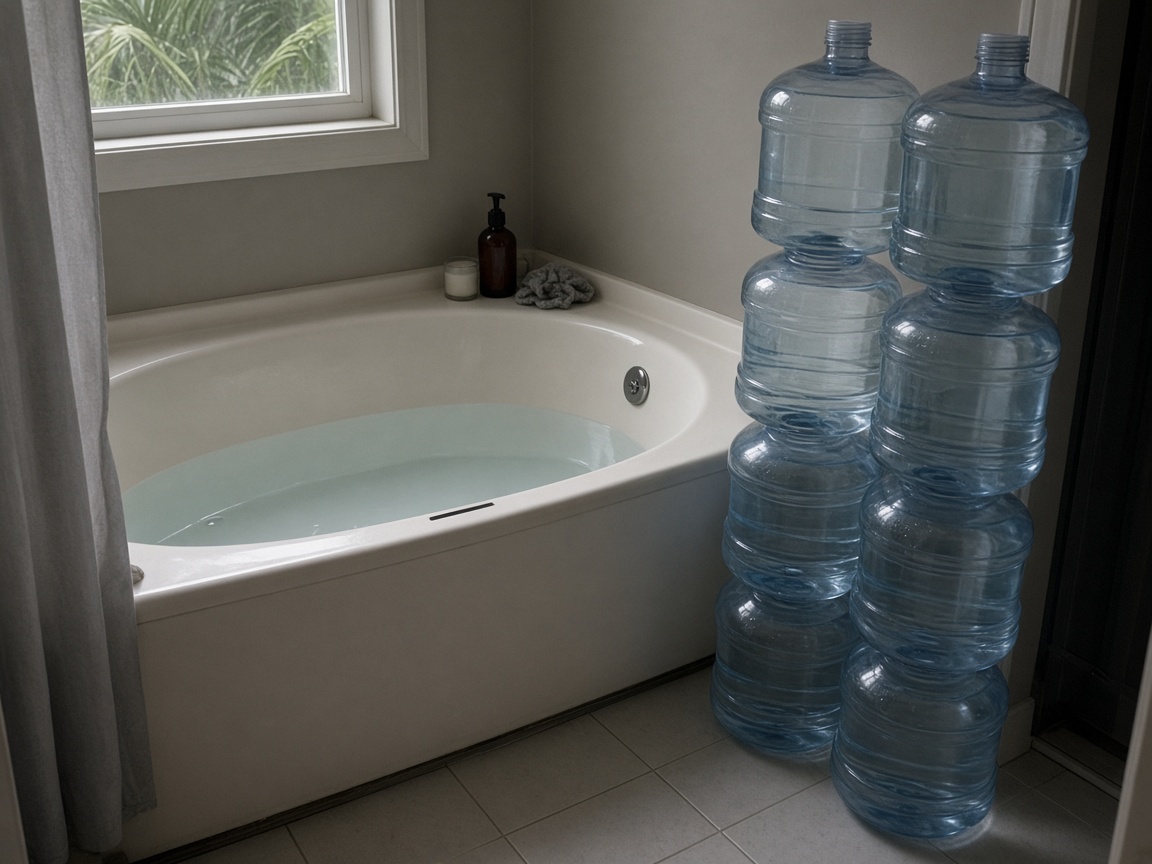
Power loss can shut down municipal water treatment and pumping. Fill bathtubs, sinks, and clean buckets with water for washing and flushing toilets, and see Ready.gov/water for guidance on storing and treating drinking water. Keep sealed bottled water separate and reserve it for drinking.
5. Charge Everything, Then Conserve Power
Charge phones, laptops, and power banks while you still have electricity. During and after the storm, text instead of calling — text messages are more likely to get through when networks are congested, and the National Weather Service and FEMA both recommend it. Keep your refrigerator and freezer closed as much as possible; an unopened refrigerator will hold food safely for a meaningful stretch without power. Also enable Wireless Emergency Alerts on your phone if they aren't already on, and keep a battery radio tuned to NOAA Weather Radio or a local station.
6. Handle Utilities and Outdoor Items
- Turn off propane tanks, as FEMA advises for flood-prone areas.
- Only shut off natural gas if officials instruct you to or you smell or hear a leak. Shutting it off unnecessarily means a utility professional has to restore it later.
- Unplug sensitive electronics to protect them from surges when power returns.
- Move or secure outdoor items — grills, propane cylinders, lawn furniture, trash cans, and chemicals — so they don't become projectiles or contaminate floodwater.
- Never use candles. Fire risk is a serious hazard when power fails and water may be unavailable for firefighters.
7. During the Storm: Rules That Save Lives
- Stay inside until officials give the all-clear. The calm of the hurricane's eye is not the end of the storm — the second half of the eyewall can be just as violent.
- Keep away from windows and exterior doors at all times, even if glass is rated for impact.
- If a tornado warning is issued (hurricanes routinely spawn tornadoes), move to your interior room on the lowest floor and cover your head.
- If water starts rising inside the home, move to a higher floor and take your supplies with you. Do not go into a closed attic where you could be trapped by rising water — take something with you to break through the roof if necessary.
- Do not wade or swim in floodwater. It can hide sharp debris, live electrical lines, sewage, and wildlife. This is the core message behind the Turn Around Don't Drown campaign.
8. After the Storm: Wait, Then Check Carefully
The hours after a hurricane are statistically some of the most dangerous. Downed power lines, carbon monoxide from generators, gas leaks, and contaminated floodwater cause injuries and deaths long after the wind stops.
- Stay put until local officials announce it is safe to go out.
- Treat every downed wire as energized. Report it and stay far away.
- Never run a generator, grill, or camp stove indoors, in a garage, or near a window or vent. Carbon monoxide is invisible and deadly. See Ready.gov/power-outages.
- Follow any boil-water notice issued by your utility and discard food that has been above safe temperatures.
- Photograph damage before you clean up, and contact your insurance company promptly.
The Bottom Line
If you can't evacuate, your priorities are simple and urgent: text someone your location, move into a small interior room on a non-flooding lower level, bring your water, food, medications, flashlight, radio, and phone chargers with you, and stay there until officials say the storm has passed. Then keep avoiding floodwater and downed lines. Sheltering in place is a fallback, not a first choice — but done correctly and early, it gives you the best available chance of coming through the storm safely.
About our guidance
Our guides are grounded in publicly available information from official sources such as FEMA, NOAA, USGS and Ready.gov. Information is general in nature — always verify details for your specific property and policy with official sources and your insurer.
Related guides
 InsuranceLender-Placed Flood Insurance: The Expensive Backup If Your Policy LapsesYour lender can force-place flood insurance if your policy lapses — and bill you for it, usually at a higher price. Here is how…Oct 15, 2026Read guide →
 InsuranceWhat Happens to Your NFIP Policy If Congress Lets the Program LapseCongress extended the NFIP through December 11, 2026. If the program lapses, existing policies stay in force and claims get paid…Oct 15, 2026Read guide →
 InsuranceExcess Flood Insurance: Coverage Above NFIP's $250,000 LimitThe NFIP caps flood coverage at $250,000 for the building and $100,000 for contents. If your home would cost more to rebuild,…Oct 15, 2026Read guide →