
Home Insurance Costs by State: Why Quotes Vary So Much
6 min read
On this page
Home insurance costs by state can swing two or three times for the same house. Here's what actually drives your quote, and what to check before you close.
The non-renewal letter is two paragraphs long. No explanation beyond “our underwriting guidelines.” Your neighbor two streets over has the same roof age, the same four-bedroom floor plan, and a premium that hasn't budged in three years. That's usually the moment people learn the least fun fact about homeowners insurance: where the house sits matters more than how careful you are.
Home insurance costs by state swing by a factor of two or three for identical coverage. Not because carriers are capricious, but because the math behind each address is genuinely different. Wind, hail, wildfire, rebuild costs, and how quickly your state approves rate increases all land in the same number on your bill.
Where the money actually goes

Your premium is expected losses plus reinsurance plus operating costs plus a profit margin. In quiet states, expected losses dominate and the number stays boring. In catastrophe states, reinsurance dominates, and reinsurance prices move fast after a bad year anywhere in the world.
That's why a hailstorm in Texas or a wildfire season in California can raise premiums in a state that had a calm year. Carriers buy backstop coverage globally. When their cost goes up, yours does too, usually within one or two renewal cycles.
Coastal wind is the most expensive line item
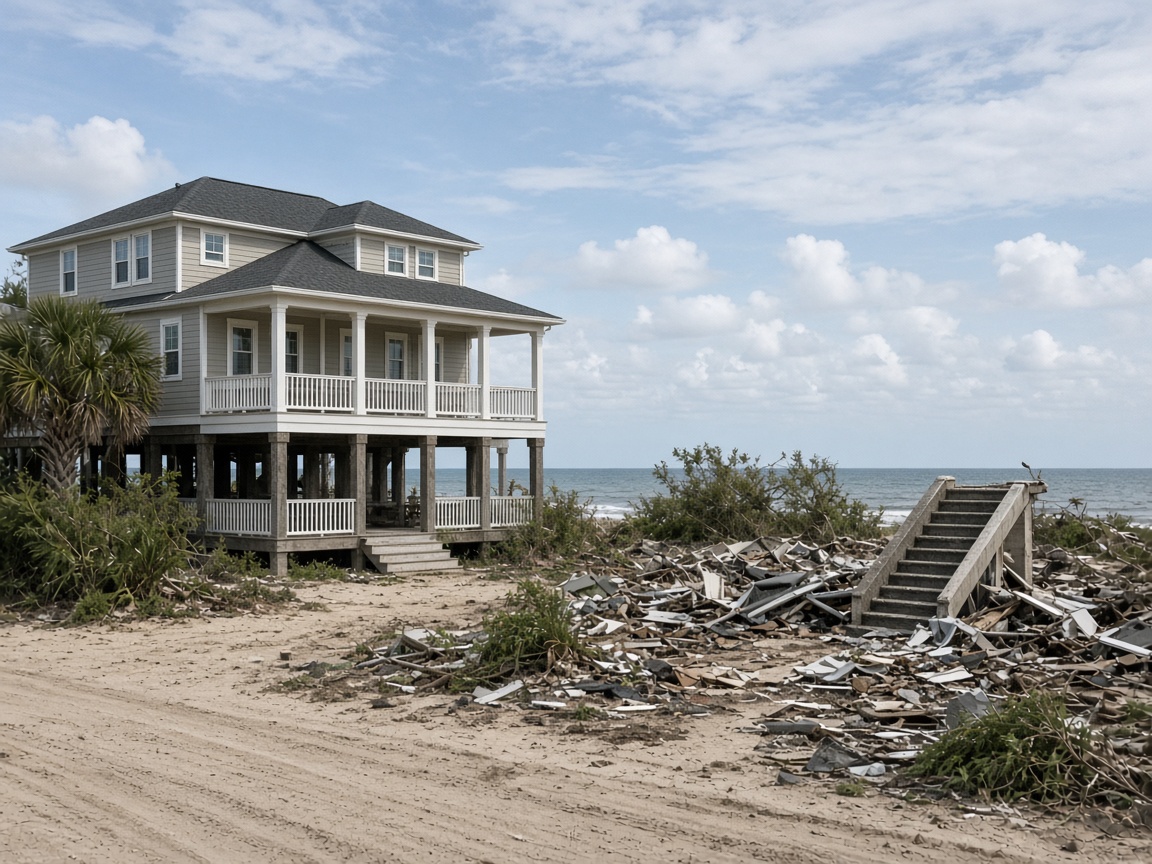
If your house sits within a few miles of salt water, you already know. Gulf and Atlantic coastal counties in Florida, Louisiana, Texas, Mississippi, Alabama, and the Carolinas carry the heaviest wind risk in the country, and the market reflects it: separate windstorm deductibles, coastal carrier subsidiaries, and in some counties, very few willing writers at all.
Florida and Louisiana have both spent recent years trying to keep private carriers in the state. California set up the FAIR Plan decades ago for the same reason. When people say the market is hardening, they mean carriers are pulling back and the state-backed option is getting crowded. You can check your own exposure through FEMA's National Risk Index and the National Hurricane Center.
Hail and tornadoes cost more than most people expect
Oklahoma, Kansas, Nebraska, Colorado, Texas, Missouri, Arkansas, and Illinois sit in the country's densest severe storm corridor. Hail doesn't flood a town or lead the news for a week. It just totals roofs, one subdivision at a time. Roof claims are a big reason those states rank high on cost lists even though they're nowhere near an ocean.
That's also why so many policies there now carry a separate percentage deductible for wind and hail, often 1% or 2% of the dwelling limit instead of a flat dollar amount. Read that line twice. On a higher-value house, a percentage deductible is real money before your carrier pays anything.
The NOAA Storm Prediction Center publishes hail and tornado climatology by state if you want to see how your county stacks up.
Wildfire is a smaller market but a sharper one
California gets the headlines, and rightly so, but Colorado, Oregon, Washington, Idaho, and parts of New Mexico and Arizona have the same problem in smaller doses. The pattern repeats: carriers stop writing new policies in the wildland-urban interface first, then non-renew existing ones, and the state's insurer of last resort absorbs the growth.
If you're buying near open grass, brush, or timber, assume you'll shop harder and possibly pay more. Ready.gov's wildfire page covers the home-hardening steps some carriers now reward with a discount.
So where is it cheap?
Broadly, states with modest wind and hail exposure and lower construction costs, including much of the upper Midwest and the interior Northeast, land at the bottom of the cost tables. But “cheap state” is a weak guide. Rates are set by ZIP code, roof age, claims history, and rebuild cost, not by a state average. One bad hailstorm can re-rate an entire metro while the rest of the state stays flat.
Use state-level data to understand the trend. Don't use it to predict your quote.
If you only do one thing
Before your inspection period ends, get quotes on the exact address. Not the ZIP code, not the city. Use an independent agent who can shop several carriers plus your state's residual market, and ask two questions in writing: what is the wind and hail deductible in dollars, and is the roof insurable at its current age? A house you can't insure is a house you can't close.
Five things you can actually change
- Your roof. Age, material, and impact-rated shingles move premiums more than almost anything else you control. Plenty of carriers won't write a roof past a certain age.
- Your deductible. Raising it lowers the premium, but a percentage wind or hail deductible changes the math fast. Know your exposure in dollars, not percent.
- Wind mitigation and home-hardening credits. Florida requires insurers to offer them, and more states are following. A roof-to-wall upgrade or impact glass can pay for itself.
- Bundling and credit. Auto-plus-home discounts and credit-based insurance scores, where your state allows them, are usually the two biggest levers left.
- Flood insurance. Separate policy, separate risk. Flood damage is excluded from nearly every homeowners policy. Check FloodSmart and your FEMA flood map even if you're outside a high-risk zone.
What not to do
Don't file small claims. A couple of modest claims can follow your address for years through the loss-history databases carriers use. Don't let coverage lapse for even a few days during a move, since a gap makes you look like new, unproven business. And don't assume your neighbor's premium tells you anything. Their roof, deductible, and credit profile are all different from yours.
Questions we get
Why did my premium jump when I never filed a claim?
Because your carrier's costs went up, not because you did something wrong. Reinsurance renewals, statewide rate filings reviewed by your insurance department, and rising labor and material costs all get passed along. Your ZIP code's storm history does the rest.
Doesn't my homeowners policy cover flooding?
No. It may cover water coming from above, like rain through a damaged roof, but not rising water. Flood coverage is a separate policy through the NFIP or a private carrier, and it typically carries a waiting period of about 30 days before it takes effect.
Can my state stop a rate increase?
Every state has a department of insurance that reviews or receives rate filings, but the rules differ a lot. Some require prior approval, others let carriers file and use rates right away. If rates feel out of control where you live, look up what was actually filed and why. The National Association of Insurance Commissioners links every state regulator.
Official sources
- FEMA National Risk Index — county-level hazard and expected loss data
- FEMA Flood Map Service Center — find your flood zone before you close
- FloodSmart (NFIP) — what flood coverage costs and what it covers
- NOAA National Hurricane Center — storm tracks and seasonal outlooks
- NOAA Storm Prediction Center — hail, wind, and tornado climatology
- Drought.gov — dry-fuel conditions that feed wildfire seasons
- USGS Earthquake Hazards Program — shaking risk, which homeowners policies exclude
- Ready.gov — home hardening and preparedness guides
- NAIC — locate and compare your state insurance department
Your premium isn't a verdict on your housekeeping. It's a guess about weather, rebuild costs, and how many other people in your county file claims. Get the address-level quote, read the deductible lines, and buy flood coverage on its own. Everything else is noise.
About our guidance
Our guides are grounded in publicly available information from official sources such as FEMA, NOAA, USGS and Ready.gov. Information is general in nature — always verify details for your specific property and policy with official sources and your insurer.
Related guides
 InsuranceLender-Placed Flood Insurance: The Expensive Backup If Your Policy LapsesYour lender can force-place flood insurance if your policy lapses — and bill you for it, usually at a higher price. Here is how…Oct 15, 2026Read guide →
 InsuranceWhat Happens to Your NFIP Policy If Congress Lets the Program LapseCongress extended the NFIP through December 11, 2026. If the program lapses, existing policies stay in force and claims get paid…Oct 15, 2026Read guide →
 InsuranceExcess Flood Insurance: Coverage Above NFIP's $250,000 LimitThe NFIP caps flood coverage at $250,000 for the building and $100,000 for contents. If your home would cost more to rebuild,…Oct 15, 2026Read guide →