
Filing a Hurricane Isaias Insurance Claim: Steps & Deadlines
6 min read

On this page
- Step 0: Safety Comes Before Paperwork
- Step 1: Report Your Claim Immediately
- Step 2: Know Which Policy Pays for What
- Step 3: Document Everything Before You Clean Up
- Step 4: Make Temporary Repairs and Prevent Further Damage
- Step 5: Meet the Adjuster and Get Independent Estimates
- Step 6: The Deadlines That Actually Matter
- Step 7: If Your Claim Is Denied or Underpaid
- Protect Yourself From Contractor Fraud
- The Bottom Line
A practical, step-by-step walkthrough of the hurricane insurance claim process — what to document, which policy pays for what, the deadlines that matter, and what to do if your claim is denied or underpaid.
A note on timing: Hurricane Isaias came ashore in North Carolina in August 2020 and tracked up the East Coast, downing trees, damaging roofs, spawning tornadoes in several states, and leaving hundreds of thousands of homes and businesses without power. Standard claim and appeal windows for that storm have closed for most policyholders. If you still have an open, underpaid, or denied Isaias claim — or you are working through a newer storm — the steps below are the same ones FEMA, the National Flood Insurance Program (NFIP), and state insurance regulators tell homeowners to follow.
Step 0: Safety Comes Before Paperwork

Do not re-enter your home until local officials say it is safe. Floodwater and standing water can be contaminated and can hide electrical hazards, sharp debris, and wildlife. Downed power lines are a leading cause of post-storm fatalities — treat every line as live. Follow Ready.gov's hurricane guidance and flood safety guidance, and see the CDC's disaster safety and cleanup pages for advice on mold, generators, and chain-saw injuries.
Only after it is safe to be inside should you start documenting damage.
Step 1: Report Your Claim Immediately
Call your insurer or file through its app or website as soon as you can. You do not need a final dollar figure to open a claim — you only need to report that a loss occurred. When you file:
- Write down the claim number, the name of the person you spoke with, and the date and time.
- Ask what documentation the adjuster will want and how to submit it.
- Start a simple claim diary — a notebook or a spreadsheet — and log every call, email, and visit.
- If your insurer is unreachable or unresponsive, contact your state's department of insurance consumer hotline. You can find it through your state government website.
Step 2: Know Which Policy Pays for What
After a hurricane, damage is often caused by a mix of wind, rain, and water — and those are covered differently.
- Homeowners insurance typically covers wind damage, wind-driven rain that enters through a storm-created opening, falling trees, and tornado damage.
- Flood insurance is separate. A standard homeowners policy does not cover rising water or storm surge. That takes an NFIP policy or a private flood policy. Learn more at FloodSmart.gov and FEMA's flood insurance page.
- Hurricane deductibles are often a percentage of your dwelling coverage — not a flat dollar amount — and in some states they apply once per named storm season. Check your declarations page.
- Additional Living Expenses (ALE) may reimburse hotel, meal, and laundry costs if your home is uninhabitable. Save every receipt.
- Auto damage is usually handled under the comprehensive portion of your auto policy.
If both wind and flood may have damaged your home, file with both insurers. Disputes over which peril caused what are common, and filing both protects you.
Step 3: Document Everything Before You Clean Up
This is the single most important thing you can do for your claim.
- Photograph and video each room, each damaged exterior surface, and the roof from the ground. Take wide shots and close-ups.
- Make a written inventory of damaged or destroyed items: what it was, roughly when you bought it, and what you paid if you know.
- Keep damaged items until the adjuster has seen them. If you must throw something out for health or safety reasons, photograph it first and note why.
- Save receipts for emergency repairs, temporary lodging, and anything you buy to protect the property.
Step 4: Make Temporary Repairs and Prevent Further Damage
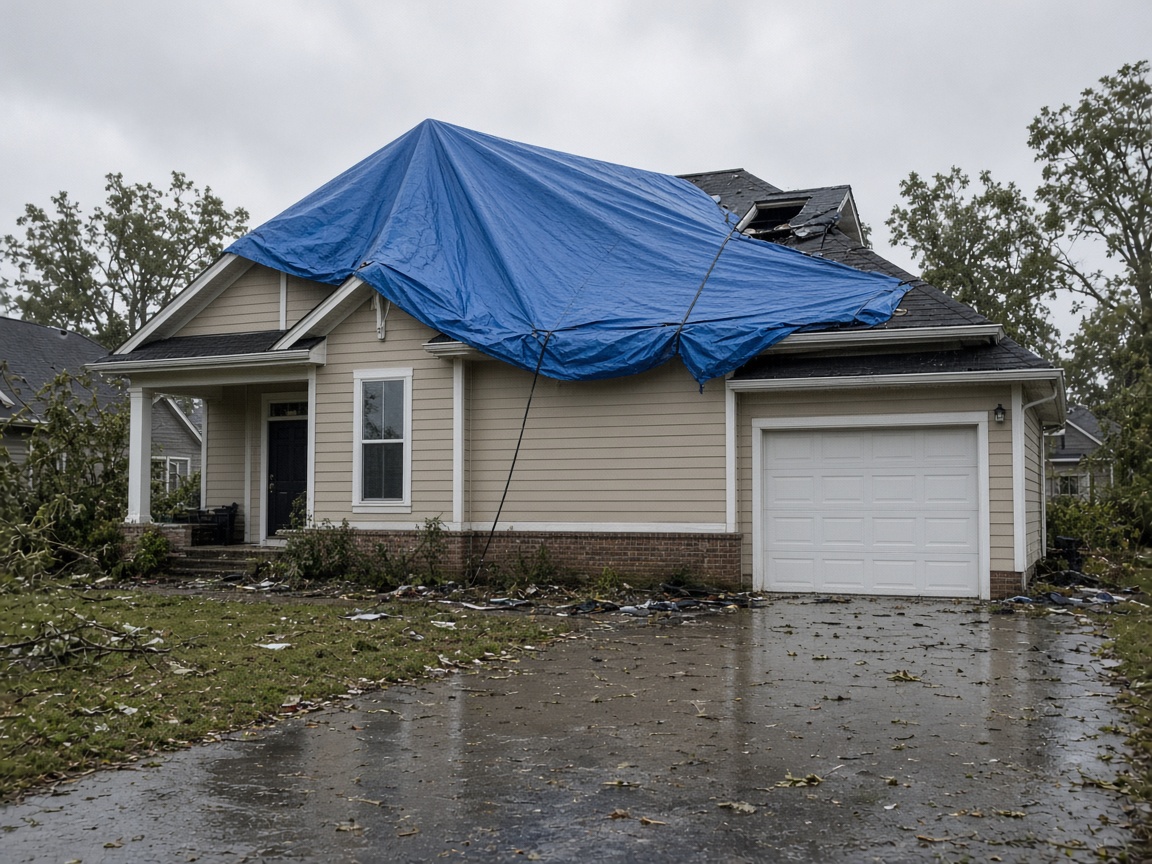
Most policies require you to take reasonable steps to prevent additional damage — think tarps, boarding up broken windows, and drying out wet areas. Keep every receipt; these costs are often reimbursable on top of your claim.
Avoid permanent repairs until the adjuster has inspected, unless a repair is genuinely necessary to make the home safe or livable. If you do proceed, document the condition before work begins.
Step 5: Meet the Adjuster and Get Independent Estimates
- Be present for the inspection if you can, and walk the property with the adjuster.
- Get the adjuster's report or a written summary, and ask questions about anything that was left off.
- Collect at least two or three written estimates from licensed, insured contractors for anything significant, such as a roof.
- Never sign a contract you do not fully understand, and never pay the full cost of a job upfront.
Step 6: The Deadlines That Actually Matter
Every policy has a "duties after loss" section that requires you to give prompt notice and to cooperate with the investigation. Beyond that, watch these specific clocks:
- Proof of loss (NFIP flood claims): generally due within 60 days of the date of loss, unless FEMA has issued an extension for your area.
- FEMA individual assistance: applications are normally due within 60 days of the disaster declaration. Apply at DisasterAssistance.gov or by calling 1-800-621-3362.
- Small Business Administration disaster loans: these have their own filing deadlines, and the SBA is the main source of long-term federal rebuild funding for homeowners.
- Flood claim appeals: an NFIP appeal is generally due within 60 days of the denial letter.
- State prompt-payment rules: most states set timelines for how quickly an insurer must acknowledge and pay a claim. Your state insurance department can tell you what applies to you.
Because deadlines can be extended after large disasters, confirm the current date with your insurer or the FEMA disaster recovery center rather than relying on memory.
Step 7: If Your Claim Is Denied or Underpaid
You have more options than most homeowners realize.
- Request the denial or underpayment in writing, with the specific policy language cited.
- Submit your own documentation: photos, contractor estimates, and an itemized inventory.
- Ask about your policy's appraisal or mediation process for valuation disputes.
- File a complaint with your state insurance department — this is free and often effective.
- Look into FEMA's Disaster Legal Services and state legal aid for free help after a declared disaster.
Do not cash a settlement check marked "final" if you disagree with it, and get advice before signing a release.
Protect Yourself From Contractor Fraud
Storm-chasing contractors appear after every hurricane, and Isaias was no exception. Red flags include demands for full payment upfront, pressure to sign an Assignment of Benefits that hands your claim rights to a third party, and offers to "handle everything" with your insurer for you. Verify a contractor's license and complaint history with your state licensing board. And remember: FEMA never charges a fee to apply for assistance, and no legitimate party should charge you to file your own claim.
The Bottom Line
After Isaias or any hurricane, speed and documentation win claims. Report the loss right away, photograph everything before you clean up, keep every receipt, put all communication in writing, and read your policy's deadlines carefully. If your claim stalls or comes back short, escalate — in writing, to your insurer, to your state insurance department, and to FEMA if you have a flood policy. For current storm forecasts and warnings, check the National Hurricane Center and weather.gov.
About our guidance
Our guides are grounded in publicly available information from official sources such as FEMA, NOAA, USGS and Ready.gov. Information is general in nature — always verify details for your specific property and policy with official sources and your insurer.
Related guides
 InsuranceLender-Placed Flood Insurance: The Expensive Backup If Your Policy LapsesYour lender can force-place flood insurance if your policy lapses — and bill you for it, usually at a higher price. Here is how…Oct 15, 2026Read guide →
 InsuranceWhat Happens to Your NFIP Policy If Congress Lets the Program LapseCongress extended the NFIP through December 11, 2026. If the program lapses, existing policies stay in force and claims get paid…Oct 15, 2026Read guide →
 InsuranceExcess Flood Insurance: Coverage Above NFIP's $250,000 LimitThe NFIP caps flood coverage at $250,000 for the building and $100,000 for contents. If your home would cost more to rebuild,…Oct 15, 2026Read guide →